
Memories of Anstey Schools
Memories of school in Anstey By Brian Kibble
Bradgate Road infants:
I was four and a half years when I started school just as the WW2 started in September 1939
Miss Pollard was my first teacher – she had a light grey moustache and beard! – nearly all teachers were addressed as “Miss” married or not.
Carrying a gas mask was compulsory slung over one shoulder with a beaker in a bag on the other shoulder. The beaker was for a hot drink of cocoa because the school heating was limited in the winter of 1939-40. The pottery beakers often got broken and were replaced with enamel – army issue!
We had a government issue of a half pint bottle of milk every day drunk through a straw.
We sat in desks made for two complete with inkwells and one of the class (not me) had the elevated position as ink monitor whose job it was to replenish the wells at the end of the day.
One of the earliest memories was taking my Mum’s aluminium jelly mould and adding it to the huge collection of metal items in the playground donated for the Spitfire fund
We soon had new non-Anstey class members when evacuees were designated across the village
In my last year at Bradgate Road a lasting memory was our Headmistress Miss Bickley on Empire Day showing us a very large map of the World hung on the classroom wall and hearing her say “all those bits in red are ours (British)” – 458 million 20% of the World’s population and 22% of the Worlds land mass.
And so on to our next adventure – Latimer St Primary in 1944
Latimer Street Primary
Where boys were separated from girls in the entrances and their playgrounds – I wonder why? The Girls and Boy’s names are still today over the doors cast in concrete.
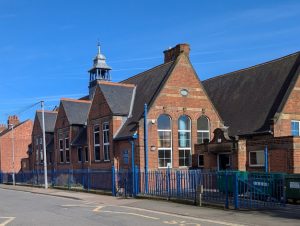 Playground memories of “weak osses” – where teams took it in turn to jump as hard as possible onto the line of backs of the other team to collapse it and also the long slides on snow and ice in the winters in full sight of the masters on duty in the playgrounds. Health and Safety would have had a field day if it had existed. Targets for our snowballs were chalk drawn pictures of Hitler and Mussolini.
We watched and identified with pride the British bombers going overhead – some with gliders attached
Memory of one of our class bringing a banana to school and us crowding around to have a look at something we could hardly remember from 4- to 5-year-olds. His brother was in the RAF and had smuggled it in.
“Tagger” Taylor was our Headmaster who brought his dog to school every day and walked it in the playground
Two of our teachers at that time were husband and wife – Mrs Evatt was a terror and the memory of a girl in our class being called out to the front of the classroom for some misdemeanour and the frightened girl wetting herself in front of all of us and seeing it run down her leg! Her husband “Daddy” Evatt was the opposite and we were fortunate to have him for the 11+ exam which a lot of our class passed and we were given the choice of Quorn Grammar School, Loughborough Grammar School or Loughborough College.
After visiting the College which had the use main College (now today’s University) with its 16 football pitches, six rugby pitches, cricket grounds, tennis courts, outdoor and indoor swimming pools, a world renown athletics track – Seb Coe later used it before the Olympics, gymnasiums, chemistry and biology labs, metal and woodworking rooms – for us with just a playground at Anstey, was there any other choice and indeed the majority of us opted for the College over the next five years entailing buying a uniform, a free 20 mile round trip five and a half days a week usually on Prestwells utility bus for the boys with wooden seats. The girls who mainly went to Quorn usually had the luxury coach with curtains at the windows.
A New School
At long last Anstey’s new primary school is well on the way, bringing with it much needed relief for Latimer School. For some years, Latimer’s population has hovered around the 700 mark; much too big for a primary school. Even with an ever increasing number of mobile classrooms. The accommodation problems have been formidable.
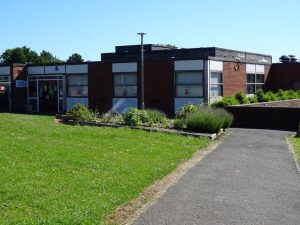 Now the new school, which is planned to provide 280 places, is taking shape on a site off Link Road and Netherfield Close. It is due for completion in August and the first intake of children should be going there after the summer holiday.
As yet the school has no name and no managing body, but it does have a headmistress, Miss. Patricia Wells, who is now deputy head of Desford Junior School. She takes up her new post in April and from then on she will be appointing staff, ordering supplies and generally getting ready to launch the new venture when the building is complete.
To begin with Miss. Wells will be operating from a desk at County Hall, but she hopes to spend a good deal of time in Anstey during the summer, getting to know the children and parents. “I’d like to spend a good deal of time in Anstey during the summer getting the feel of Anstey and perhaps go into Anstey Latimer School and work alongside the other teachers” she told me.
She would also like to invite the parents to come along and meet her.
The catchment of the new school has not yet been finally approved by the Education Committee, but the dividing line is expected to be in the region of Albion Street and Dalby Road. All children living to the north of the dividing line will normally go to the new school although there will be some exceptions in the early part of the school’s existence.
None of the fourth year at Latimer School will transfer, since they are so near to moving to the Martin School it would not be fair to ask them to change schools twice in successive years. It may also be possible to offer a choice to those families where brothers and sisters might be split – one staying at Latimer and others going to the new school. In such cases it may be possible to keep brothers and sisters together at Latimer, if parents wish. If this is allowed however, it should be understood that children staying with older brothers or sisters will not be able to move to the new school later.
Yet Miss. Wells is anxious that there should be no feeling of competition between the two schools. “The new school is not in any sense going to set up in opposition,” She said. She has every intention of continuing the close so-operation which already exists between her and Mr. Beck.
What will the new school be like? It will certainly be very different from Latimer – very modern, built to an open plan design, but benefitting from the lessons which have been learned from years of experimenting with school architecture in this County.
It will therefore lend itself to the best of modern methods of teaching. Yet Miss. Wells is anxious no to lay down policy guidelines for the school at this stage. “The development of a school is very much a team matter,” she says. “It is a question for consultation among the teaching staff when they are appointed.”
But she plans to visit a number of other schools of similar size and to compare their methods of working. One thing she will say is that the school will be ‘confidence building’ for both staff and children. “They won’t feel lost in a sea of people.”
She is also determined that it shall be an ‘open’ school. “People will always be welcome, the school will be part of the village and will always be open to parents and friends.”
And what of Latimer School? With numbers coming down to below 500 for the first time for many years – though they will still climb over this figure in the latter part of each school year – the pressure on space will be very much reduced. Some of the mobile classrooms will go and the playground space which they have occupied will be brought back into use. There will also be more adequate cloakroom space for children’s possessions.
Some of the staff will be going too, of course. With smaller numbers the present level of staffing will not be needed. But the new slimmed down Latimer will in many ways be even better than the school has been in the past.
It will be still be one of the larger primary schools in the area and still larger than some might wish – ideal size in Mr. Beck’s opinion is no more than 350. But he emphasizes that the smaller number of pupils will make it much easier to obtain a corporate spirit and a common approach to the work of the school.
“Children will benefit from the fact that they should be able to make closer relationships with more teachers,” he said, “and in time the staff should get to know the pupils well. Obviously communications within our school must improve and group discussions between staff should be more valuable, as they will allow more individual participation. Also the general lack of space which is apparent everywhere here will be relieved and this will allow for better working and living conditions.”
There are still many problems to be sorted out concerning the change, but from now on there should be a steady flow of information to the parents affected. A formal letter of explanation to parents should be going out in the latter part of March and during the summer term there will be every opportunity for consultation with both Miss. Wells and Mr. Beck.