
Anstey Memoir (Writer Unknown)
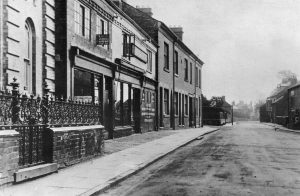 Cottage doors stood open along the village street and women could be seen finishing off their bundles of shoe work ready to be returned to the factory next morning by their children on the way to school.
One old woman, grey shawled and with a man’s cloth cap, glared at us as we went by and shouted ‘Foreigners!’ Years later I told a born and bred villager of this incident, by then knowing and naming the old dear, and the reply was ‘She should shout, she’s a foreigner herself from Shepshed!’
Our village boasted a cinema in those days. The Tin Shed, as its nickname implies, was a corrugated iron building furnished with wooden benches. There was many a fight at the Saturday Matinee, or ‘Tuppeny Rush’ to get a seat near the tortoise stove on wintry afternoons.
Lurid spy thrillers fired the imaginations of Anstey’s youth, and when I started school and it became known that I came from foreign parts (Canada actually), I was regarded with deep suspicion, half in fun, half in earnest. This didn’t, however, prevent my lunchtime sandwich or slice of seedcake being snatched by some hungry infant, never quite satisfied with the wartime rations, and whose own snack had probably been consumed on the way to school. I was a puny child with little appetite and didn’t really mind except for the indignity.
I remember the roads of the village before they were macadammed, thick with white dust in dry weather and equally thick with mud after rain. But woe betide us if we appeared in school with dusty boots. Yes! Little girls wore boots then, often high legged and tightly buttoned. We used to polish each in turn upon the backs of our long black woollen stockings before going into the school playground.
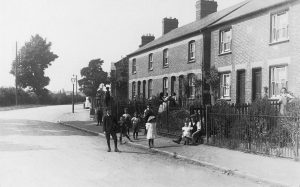 As a child I accepted and used all the nicknames for people and places, only wondering as I grew older how they came about. An estate of new roads with plots earmarked for buildings and known as ‘Klondyke’ was easy, likewise the allotments or ‘Gold Diggings’, but ‘Top Lanny’ and ‘Bottom Lanny’ defeated me for years. It was the aforementioned villager who gave me the clue. She told me how she had bought a plot of ground at half-a-crown a week. Upon further enquiry it transpired that land had been put up for sale at each end of the village (top and bottom) through a Land Society. Members paid a small deposit to join and paid off the rest weekly. Many of the plots were just gardened for years, but some more fortunate and thrifty people were able to build a small house or even two or three, living in one and letting the other one or two.
There is one house still to be seen, though whether a Land Society one I cannot say, that has a plaque high on one wall that says ‘Fruits of Industry’.
There used to be two bus proprietors. The village carrier owned an eight-seater and went into town at 10:00 am returning at 1:00 pm. He made an extra journey on market days at 2:00 pm, returning at 6:00pm. The larger bus made journeys at similar times with extra trips on Saturdays. When petrol got scarce and expensive, this one was fitted with a gas balloon on top, to the delight of we children, and I regret to say that we were still more delighted when bus, driver and passengers were blown into a flooded ditch one stormy day.
With transport so limited, trips to town were infrequent, perhaps once at Christmas to see the shops and once to be rigged up for the ‘Sermons’, though most people relied on the travelling draper for the new sermons frock or suit. He gave good value and is still remembered for his kindness to many a family when sickness or unemployment put them temporarily behind with their payments, but real backsliders got short shrift.
There was much rivalry between the three Chapels and the parish Church. The Church rounded off the series, always coming a very poor fourth in the matter of sermons collections, and the Church children had to endure much scorn poured on them by the more affluent or probably more generous Chapelites. There was much attempted gatecrashing at each other’s treats, efficiently dealt with by the appropriate Parson and his helpers, for in those days everybody knew everybody and a glance revealed the offender as ‘Congs’, ‘Prims’, ‘Wesleyan’ or Church.
The other highlight of the year was Anstey Wake in September when the shows came and we had two days’ holiday. Now the noisy old steam horses and flaring Naptha lights are only a memory, and dodgems and Walls of Death come at any time or not at all, but there is still a tasty little cabbage that comes in for mid-September known locally as an ‘Anstey Waker’ though I don’t suppose young gardeners know why.
In 1921 I won a scholarship to the Newarke School. I had no bicycle, so it meant walking to and from school across the then unmade Gorse Road, across a field path and through allotments, now Buckminster Road, catching a tramcar for the last leg of the journey. No mean feet for a small girl carrying a satchel of books, packed lunch and hockey stick or tennis racquet on games day. Then there was a further walk to the playing field near Victoria Park, when after hockey, netball or tennis the long trek home, tea, and nose down for homework.
After two years of this, another bus company started up running a more frequent service, and the journeys were easy until the end of my schooldays. It was easier, too, for people to get to town for work, shopping and recreation, and village life as my generation knew it came to an end.