
St Mary's Church Trail
Introduction to St Mary’s Church, Anstey
The oldest part of the church is the remains of the Saxon Preaching Stump in the churchyard.
It is believed that Saxon missionaries would first visit an area, bringing with them a wooden cross and preach to the local people from a piece of high ground.
The wooden cross would be placed to mark the meeting, followed later by a stone structure.
A wooden building would subsequently be built.
Often, the head man of the settlement would be the first convert, followed by the rest of the settlement.
There was definitely a church in this place in Norman times as both the tower and doorway in the tower are from that period, possibly circa 1150.
In 1552 a commission reported that the church in Anstey contained:
- 3 bells
- 1 cope (from the Medieval period onwards this was a vestment made from highly decorative material and used on special occasions.)
- 2 suetes of vestments
- 1 chalice
- A cross of brass
The very first church would have existed in its own right; later consolidated with the parish of Thurcaston and becoming a Chapelry.
A Chapelry was a subdivision of a larger parish, but with a church of its own so people could attend a church without travelling large distances.
Interestingly, although Thurcaston was the main church and Anstey was a chapelry within Thurcaston and Cropston Parish, the population in Thurcaston was only 324 people, whereas in Anstey it was 750.
By the 1840s the population of Anstey was increasing rapidly and the church had outgrown its capacity of 250 seats for its congregation.
In 1845 Rev Waterfield, who was the Rector at this time, funded the rebuilding of St Mary’s to accommodate a congregation of 500.
This meant demolishing the Nave and Sanctuary and building over some of the churchyard.
The cost was about £7000.
In addition, a new Rectory was built on Bradgate Road, just up from The Green to replace the one nearer the Church and a house on Church Lane became the home for the newly created post of Anstey curate.
The site of the new Rectory meant that it was actually in the Parish of Newtown Linford, as until 1952 the Anstey Parish boundary stopped at the point where Link Road is now.
The land was at the time owned by the Earl of Stamford and was probably donated for the building of the Rectory.
In 1867 St Mary’s became a separate Ecclesiastical parish, with its own Rector.
A list of all the Rectors of St Mary’s can be found in the church.
It is your responsibility to be aware of whether you are allowed to access any area, to follow the Highway Code, and to be observant of any hazards which may be present along or near your route.
If you experience any issues while following the trail please Contact Us and provide a description.
We hope you enjoy the trail and we would really appreciate your feedback.
Map showing Start of Trail
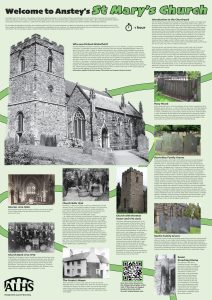
Map view of the St Mary’s Church Trail starting point
Street view of the St Mary’s Church Trail starting point
Clicking the links will either open a new tab on your browser or the Google Maps app
Start the trail outside St Mary’s Church in front of the tower.
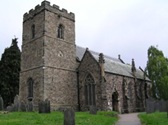 The tower of the church is the only remaining part of the Norman church and it is here you find the bells and the clock.
The Bells
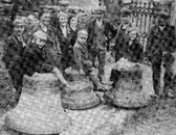 The first mention of bells at St Mary’s is in 1552 when a commission reported that ‘the church in Anstey contained 3 bells.’
The 3 bells of 1550 were increased to 5 in 1723 and were probably cast on site.
An inscription on one of them is
J.W. Halton recast us all anno MDCCXXIII (1723).
J. W. Halton was a foreman at a bell foundry in Bawtry, Yorkshire.
When this closed down, he travelled the country, recasting church bells, setting up his furnace in a nearby field.
It is thought that the 5 bells may have been made from the same metal as the 3 large original bells.
In 1906 the 2 smallest bells were recast and 3 smaller bells added; the whole peal of 8 hung in a new frame, the work being carried out by John Taylor and Co. of Loughborough.
In 1936 the 6th, 7th and tenor bell were recast again.
The recasting was done just after George V’s death and Edward VIII had ascended to the throne.
The tenor bell carries the inscription, ‘Recast in the year of the accession of King Edward VIII.’
Edward abdicated in favour of his brother, the future George VI, but it must have been decided that it was too expensive to recast the bell again. Thus, it is the only bell in the country to bear this inscription.
Inscriptions on bells.
Treble: John Taylor and Co. Founders Loughborough 1906
2nd: Oh worship the King in the beauty of holiness.
To the glory of God
from Robert Frewin Martin and Henrietta Susan Martin 1906
John Taylor and Co. Founders Loughborough 1906
3rd: John Taylor and Co. Founders Loughborough 1906
J Kerry Williams, Rector, W Morris, J. Burchnall CW
4th: God reward my Benefactors Recast 1906
5th: J.W. Halton recast us all anno MDCCXXIII
Recast 1906
6th: Recast 1906
7th: Recast 1906
Tenor: William Handstaff, John Lewis CW
Recast in the year of the ascension of King Edward VIII J. Stewart Rector, S.T. ???, J.A. Bramley Church Wardens 1936
The Church Clock
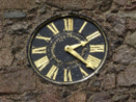 This was made by W. Jolley of Leicester. It was given to the church in 1772 by Robert and Thomas Martin, father and son, who at the time were churchwardens.
As it was the only public clock in the village it would have been the standard time keeper and regulated the life of the village.
Before the advent of clocks, the church bell announced the time to the village population.
The first bell at 6.00 a.m., told the nightwatchman that he could end his vigil and go to bed.
At the same time, it called people to prayers and daily mass.
The angelus bell was rung at 12 noon and the curfew bell at 8.00 p.m.
The curfew bell told the population to cover up their fires; a necessary precaution as at this time many people slept on straw mattress near to their fires.
Follow the path around the tower until you reach a doorway.
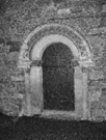 This is the only remining Norman doorway from the original church.
Look towards the gate on Church Lane.
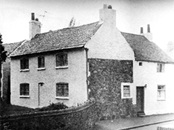 The Curate’s House.
The house you can see to the left, was where the church curate lived.
You can see the outline of a door. This meant the curate could come straight out into the churchyard.
Retrace your steps, back round to the other side of the tower and look towards the gate onto Bradgate Road.
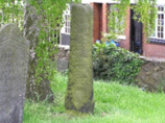 Saxon Preaching Stump
To the left is the remains of a Saxon preaching stump.
It is the oldest structure in Anstey and includes a socket stone and part of a shaft.
It is believed that Saxon missionaries would first visit an area, bringing with them a wooden cross and preach to the local people from a piece of high ground.
Often, the ‘head man’ of the settlement would be the first convert, followed by the rest of the settlement.
The wooden cross would be placed to mark the meeting, followed later by a stone structure.
A wooden building would subsequently be built.
Now spend time to explore the graves.
The churchyard was the place of burial for all Anstey residents until 1888 when the new Anstey Cemetery was opened on Groby Road (then Groby Lane), at the edge of the village.
The land for the new cemetery was given to the village by Rev W Roby Burgin in 1886 when it was realised that there was very little space remaining in the churchyard.
Most of the grave stones in the churchyard are made from local Swithland slate.
Look at the makers’ names on the bottom.
When the church was rebuilt in the 1840s many of the oldest gravestones were removed.
Most of the gravestones along the Bradgate Road wall are dated from the 1700s. It is possible that these were the graves that were disturbed during the rebuilding of the church.
The more important a person was, the nearer the main church door they wanted to be buried.
Nonconformist villagers, those who attended the Methodist and Congregational churches, had to be buried on the other side of the church irrespective of wealth and status.
Many villagers couldn’t afford a head stone, many couldn’t even afford to pay for a funeral.
This meant they were buried in unmarked pauper graves along the Church Lane wall, which is medieval and listed.
The gravestones give an insight into Anstey life in the 18th and 19th century.
Many of the graves are of children and young people and not even the wealthy were spared the sorrow of losing a young member of the family.
In 1887, there were dozens of children and infant deaths recorded in the church registers, obviously due to illness of epidemic proportions. The Lewin family had 4 family members all buried in January 1736.
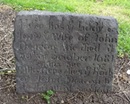 The oldest grave in situ, is that of the wife of John Deacon, dated 20th October 1681. It is sited towards the wall, overlooking the Hare and Hounds public house.
People buried in the churchyard.
All the Anstey families buried here have stories to tell.
These are just a selection.
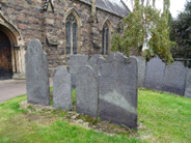 The Martin Family graves are situated nearest the church door, showing their status in Anstey.
In 1301, Robert Martin became a free man and is believed to be the first inhabitant in Anstey to do so.
This meant he was no longer tied to his lord as a serf and could farm his land in his own name.
In 1588, Thomas Martin had land leased to him by Queen Elizabeth 1 and it was on this land, just outside the village, that his descendants built ‘Anstey Pastures’ in 1833. The Martin family lived here until 1892 when they moved to The Brand in Woodhouse Eaves.
It is believed that, prior to building ‘Anstey Pastures, the family lived at The Old Ship, on Bradgate Road.
Built around 1450, The Old Ship was regarded as one of the best timber framed medieval cottages in the county.
It was demolished 1955.
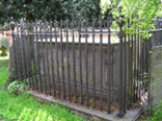 Heard Family
The large railed tomb is that of Miss Mary Heard.
Mary Heard was the daughter of John Heard, a gentleman from Billesdon and his wife Ann and was born in 1703
It is not known why Mary came to Anstey, but in 1767 the farm on the corner of Groby Road and Bradgate Road was built for her.
At this time Mary was one of the two main landowners in Anstey. Something very unusual for a woman in those days.
When she died in 1803, unmarried, she left £600 to be invested and the income to be divided between 3 parishes, Anstey being one of them.
She directed that this was to be used to buy shirts and shifts for the poor.
The graves nearby are of three generations of her family.
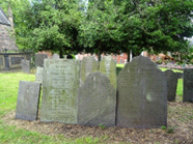 Skertchly (Sketchley) Family
The group of graves to the right of the Martin graves, towards Bradgate Road. are those of the Skertchly / Sketchley family.
This is a very interesting Anstey family.
Thomas 1738 – 1826
Thomas Skertchly or Sketchley (there are various spellings of the family name) seems to have done very well for himself during his long life.
Thomas, who was described as an architect, was commissioned by George Grey, 5th Earl of Stamford, to build a folly for him. In 1784 he received 170 pounds 1 shilling and 10 pence for work done at the village of Wilson (near Melbourne) and the ‘tower.’
This tower was Old John Tower in Bradgate Park.
Three years later he received 69 pounds 7 shillings and 2 pence.
for building Groby School, which is no longer there, and in 1800 he was commissioned to rebuild part of the Bradgate Park walls.
By that time he was working with one of his sons, probably William, who seems to have started as a builder before becoming a farmer.
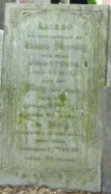 Thomas died on the 4th April 1826 aged 88 and is buried with his wife Mary.
Three of his children survived to full adulthood and it is Joseph who is most interesting.
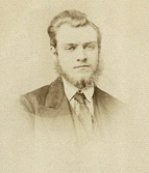 Joseph
Joseph was born in 1781.
He became a surgeon and on the 1851 census it says that he
‘is a surgeon in practise prior to the act of1815’.
In 1803 Joseph married his first wife, Elizabeth, who sadly died in childbirth in 1812, as did their newborn daughter.
From that marriage he had a daughter, Elizabeth born in 1807 and a son John who also became a surgeon, who died aged 39 and is buried at Rothley.
Joseph remarried and he and his second wife, Ann had a son, also named Joseph, who became an engineer.
Joseph Jnr had 3 sons: Sydney Barber Josiah born in Anstey in 1850; Alfred born 1847; Richard born 1853 and a daughter, Florence, born 1864.
Sydney went on to became renowned worldwide.
He was educated at King Edward’s School, Ashby-de-la-Zouch where he won the Queen’s Gold Medal for science. He then studied geology at the Royal School of Mines (later Imperial College, London) under Sir Ralph Tate and Thomas H. Huxley.
Sydney became assistant curator to the Geological Society, London.
Later he worked in East Anglia for the British Geological Survey, studying and making maps of the geologically young strata there, as well as writing about the gun-flint industry which exploited the local flints.
In 1878 Sydney sent Charles Darwin a copy of his ‘Geology of the Fenland’ and Darwin replied with a gift of his ‘Origin of Species.’ He also corresponded with Darwin’s rival and co-discoverer of natural selection, Alfred Russel Wallace.
Sydney travelled to California, Borneo and China, studying and writing on geology and wider scientific subjects. He pioneered the first ever series of science textbooks written by scientists rather than school teachers, and a system for showing relief on maps.
He travelled widely; finally settling in Australia, where he became a professor and was known worldwide.
He died in 1926.
It is amazing to think, that 3 such illustrious men, Thomas, Joseph and Sydney, were, according to the 1851 census, all living,at that time, in the same house in Main Street (Bradgate Road) Anstey.
Follow the path to the other side of the churchyard.
There are fewer marked graves on this side of the church, but those people that are buried here also have interesting stories to tell.
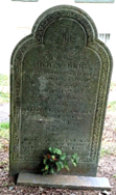 Henry Hunt (near the gate to Church Lane).
Henry’s epitaph says that he had been a Primitive Methodist lay preacher for over 60 years and yet he was buried as far away from the church as possible, due to being non-conformist.
He lived all his life in Church Lane and was a frame knitting worker.
He died in 1877 aged 79
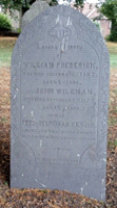 Wileman/Kestin Children
This grave is next to the path leading to the church and is particularly poignant.
Here are buried 2 brothers, William Frederick who died October 16th 1887 aged 6 and his brother John, who died 3 weeks later on November 4th, aged 2.
They were 2 of the many children who died 1887, probably as a result if an epidemic.
Their father was the village policeman who, in 1886, was called as a witness to an inquest at The Coach and Horses, concerning a man found dead in the brook.
Their mother had been a school teacher, born Wileman, and lived in Measham before her marriage.
The name of the stonemason on the head stone is Wileman, so it was probably made by a family member.
By the 1891 census, the parents had moved from the village; the father having been given a placement elsewhere.
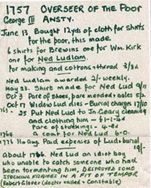 Ned Ludd (Edward Ludnam)
One of Anstey’s most notable residents, Ned Ludd is buried in this area in one of the many pauper graves.
Ned Ludd is believed to be Edward Ludlam who lived in Anstey in the mid-18th century.
Records show that he was of lowly birth and probably of low intelligence and frequently received help from the poor relief.
It is said that he destroyed some stocking frames in a fit of temper after being unable to catch someone who had been tormenting him.
The records of Parish Council show that they paid 19 shillings for his burial on the 31st August 1776.
Stocking frame workers took this name, much later in the 19th century, when they destroyed stocking frames in protest against their factory owners and called themselves Luddites.
You have completed the Churchyard Trail, but you may wish to continue to explore the graves and ‘meet’ more of Anstey’s families.
Time: Approx. 1 hour